
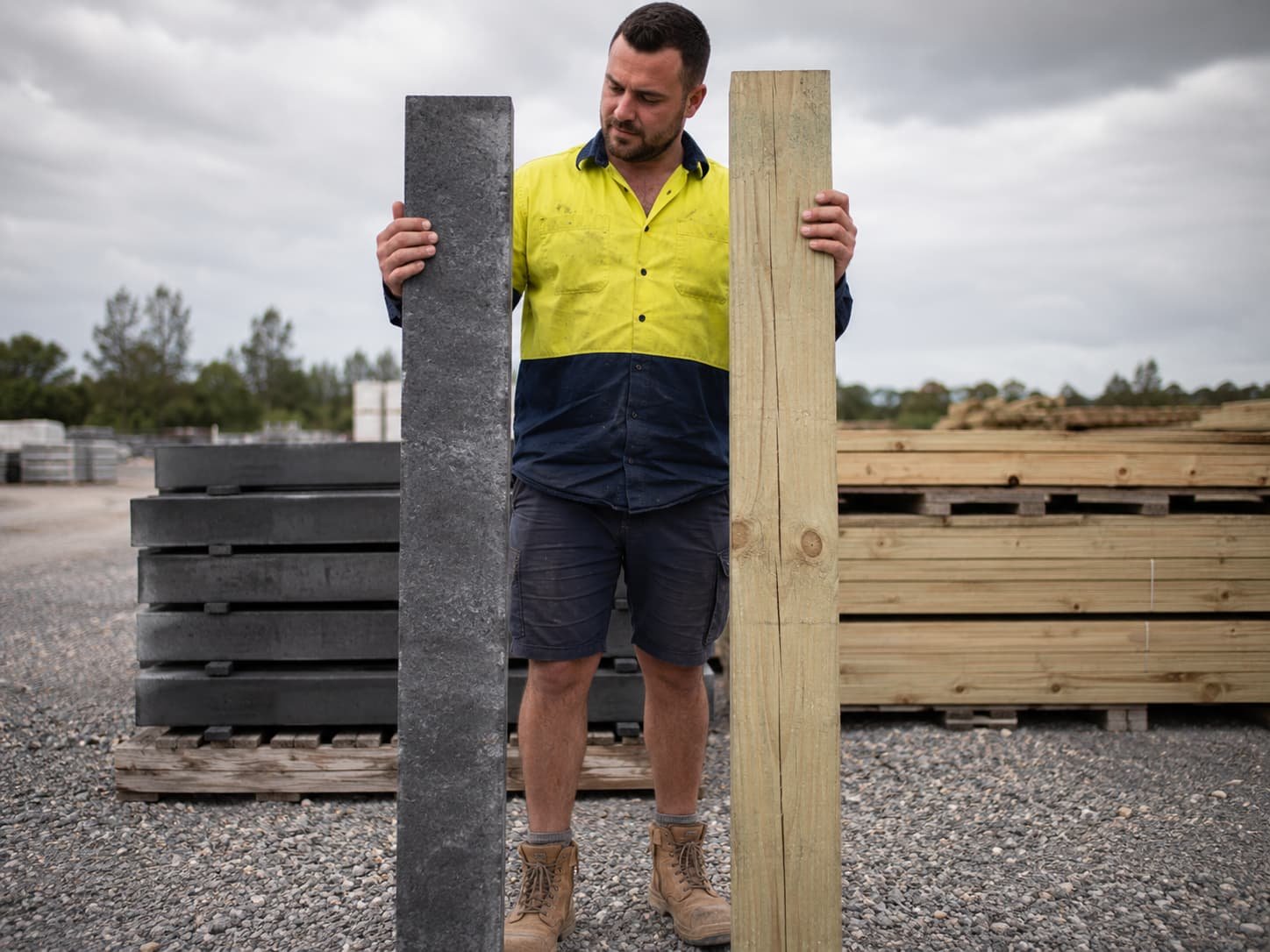
Concrete vs timber sleeper is the choice almost every Ipswich homeowner faces when they plan a retaining wall, and in a city built on reactive black clay it is a choice worth getting right. Both are proven sleeper systems, both slot between posts, and both can look great — but they behave very differently over the long run, especially in Ipswich’s soil and climate. Here is an honest comparison to help you decide.
Concrete vs timber sleeper: the short answer
If budget is the priority and the wall is a low garden terrace, timber is hard to beat on price. If you want a wall that lasts decades with almost no maintenance — especially anything tall, load-bearing or on a boundary — concrete is the better long-term value. In Ipswich’s reactive clay, concrete wins more often than not, but there is a genuine place for both.
Cost
Timber is the cheaper option upfront. As an indicative, GST-inclusive guide, a timber sleeper wall runs from around A$250 per square metre for treated pine up to about A$450 for hardwood, while a concrete sleeper wall sits at roughly A$450 to A$1,100 per square metre. The gap is real, and for a small garden wall it can be the deciding factor. But upfront price is only half the story — the wall you replace in fifteen years is not cheaper than the one you build once.
Lifespan and maintenance
This is where concrete pulls ahead. Precast concrete sleepers do not rot, warp or attract termites, and a properly drained concrete wall is effectively a set-and-forget structure for the life of the property. Timber, even well-treated timber, is a natural product with a finite life — expect fifteen to twenty years from treated pine and somewhat longer from hardwood, with the odd board needing attention along the way. Skip the drainage on a timber wall and that lifespan shortens quickly.
How each handles Ipswich’s reactive clay
Ipswich’s reactive black clay swells when it is wet and shrinks as it dries, pushing hard against any wall holding it, and the region’s heavy summer downpours pile on hydrostatic pressure behind the wall. Concrete sleepers, dense and rigid between galvanised steel posts, take that load in their stride. Timber can handle it too on lower walls, but the same moisture that drives the clay also works on the timber itself — damp conditions invite rot and termites, so timber has to be properly treated, kept up off the ground and drained hard. The taller the wall and the wetter the site, the more the balance tips toward concrete. Either way, drainage behind the wall is non-negotiable in this soil.
Looks and finish
Timber brings a warm, natural look that suits established gardens, acreage and softer landscaping. Concrete sleepers come in finishes like charcoal and timber-look profiles, giving a clean, modern edge that many new homes prefer, and they cap off neatly. It comes down to the style of your home and yard as much as anything — both can look excellent when built well.
So which should you choose?
Choose timber for lower garden walls and terraces where budget matters and the wall is not carrying heavy loads. Choose concrete for boundary walls, taller walls, anything holding a driveway or structure, and any wall you want to build once and forget. Whichever you pick, it must be built by a contractor holding the correct QBCC licence for work over $3,300, and walls over a metre need an engineered design. The concrete vs timber sleeper decision really comes down to how long you want the wall to last, and we are happy to give you the honest call for your specific block.
The best way to settle the concrete vs timber sleeper question for your yard is a free, no-obligation on-site quote. Tell us about your slope, your budget and the look you are after, and we will recommend the wall that gives you the best value over its life — not just on day one.