
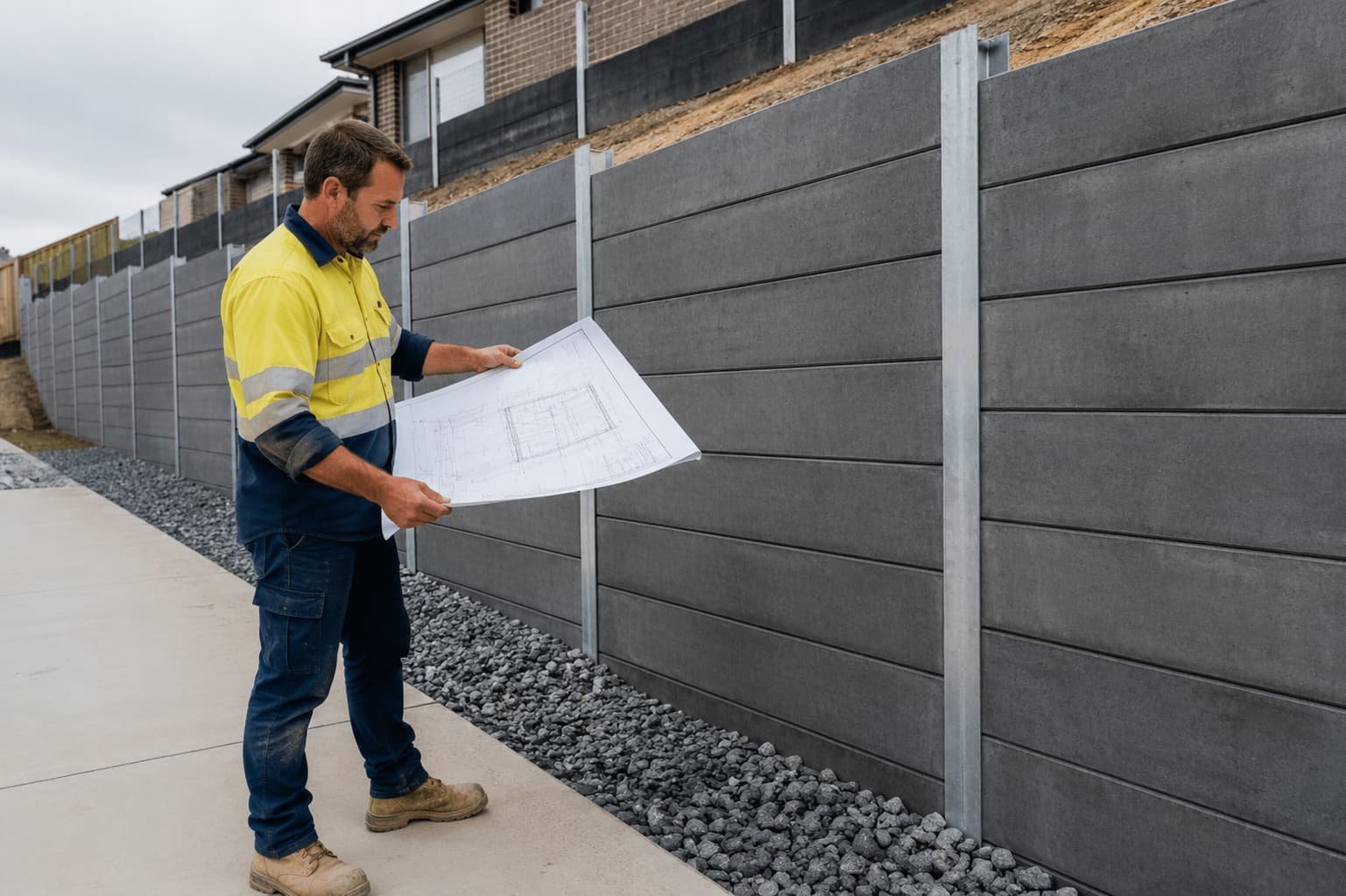
Retaining wall approval trips up a lot of Ipswich homeowners, because the rules are not about the wall alone — they turn on its height, what it is holding and where it sits. Here is a plain-English guide to when a retaining wall needs building approval in Queensland, who has to design and build it, and how it works locally in Ipswich. This is general guidance only; always confirm the specifics for your block with a building certifier or Ipswich City Council before you start.
When you don’t need building approval
Under the Queensland Building Regulation, a retaining wall is “accepted development” — meaning no building approval is required — only if it meets all three of these conditions:
- There is no surcharge loading (such as a driveway, slab, pool or building) over the wall’s zone of influence.
- The combined height of the wall and the fill or cut it retains is no more than one metre above the natural ground surface.
- The wall is no closer than 1.5 metres to a building or another retaining wall.
Miss any one of those and retaining wall approval is required before you build. Note it is the total retained height that counts, not just the visible wall — a low wall holding a tall batter can still tip over the one-metre line.
When you do need retaining wall approval
You will generally need building approval if the wall is over that one-metre combined height, carries a surcharge over its zone of influence, or sits within 1.5 metres of a building or another wall. Building over an easement is a separate problem — you cannot build over sewer, stormwater or water mains without authority. There is also planning approval to consider, which is different from building approval: if your block is affected by a flood, landslide or waterway overlay, a planning approval may be triggered too. That matters in Ipswich, where flood overlays along the Bremer River and its tributaries are common.
Who must design and build your wall
For a regulated wall, two professionals come into play. Any retaining wall over one metre must be designed and certified by a Registered Professional Engineer of Queensland (RPEQ) — that is a legal requirement, not a nice-to-have. And any domestic building work valued at more than $3,300, including labour and materials, must be carried out by a QBCC-licensed contractor. The building approval itself is issued by a private building certifier, who checks the work against the National Construction Code and the Queensland Development Code. We build to all three — QBCC licence, RPEQ design where required, and certifier approval.
Boundaries, easements and your neighbour
A retaining wall generally has to sit fully on your own property, and setbacks can apply depending on height and site conditions. If a wall is shared or sits on a common boundary, it is worth agreeing the details with your neighbour in writing first, because a retaining wall that also supports a fence can bring extra rules once the combined structure gets tall. And as above, never build across an easement without the relevant authority’s approval — it can force an expensive removal later.
How retaining wall approval works in Ipswich
In practice, approval in Ipswich runs through a private building certifier rather than the council counter, with Ipswich City Council the place to check planning overlays such as flood. The council is particularly focused on drainage given the area’s flood history, so a wall that manages water properly is not just good building practice — it helps your approval go smoothly. When we quote a wall, we flag straight away whether it will need engineering and approval, so there are no surprises. Whatever material you choose — concrete sleeper, besser block, timber or rock — the same rules apply.
If you are not sure whether your wall needs approval, the simplest step is a free, no-obligation on-site assessment. We will tell you honestly whether retaining wall approval applies to your block, and handle the engineering and certifier side for you.